
Quick Answer: In the battle for 1080p supremacy, the NVIDIA GeForce RTX 4060 is the better overall product for 2025. Despite being ~$30 more expensive than the AMD Radeon RX 7600, its vastly superior power efficiency, access to DLSS 3.5, and better ray tracing performance make it the smarter long-term buy. Choose the RX 7600 only if your budget is strictly capped at under $270.
Tale of the Tape: Specs Comparison
Before we talk frames, let’s look at what we’re paying for. The immediate difference is power consumption. The RTX 4060 is shockingly efficient.
| Feature | AMD Radeon RX 7600 | NVIDIA GeForce RTX 4060 |
|---|---|---|
| Approx. Price | $259 – $269 | $295 – $310 |
| VRAM | 8GB GDDR6 | 8GB GDDR6 |
| Bus Width | 128-bit | 128-bit |
| TGP (Power) | 165W | 115W (Efficiency King) |
One critical thing to note: both cards are limited to 8GB of VRAM. In 2025, this is the bare minimum for modern AAA gaming. If you are worried about longevity, check out our GPU VRAM Calculator Guide to see if your favorite games will hit this ceiling.
Performance: Rasterization & Ray Tracing

The RTX 4060 leads by about 15% overall, but the gap widens significantly with Ray Tracing enabled.
1. Pure Rasterization (Standard Gaming)
In standard rendering, the cards are surprisingly close. The RTX 4060 typically holds a 10-15% lead in titles like Cyberpunk 2077 and Hogwarts Legacy. However, in e-sports titles like Call of Duty or Apex Legends, the RX 7600 fights back hard, often matching the Nvidia card for $40 less.
2. Ray Tracing
This is where the battle ends. NVIDIA’s 3rd Gen RT cores crush AMD’s offerings. If you care about reflections in Control or lighting in Alan Wake 2, the RTX 4060 is the only playable option here, delivering 60+ FPS where the RX 7600 often dips below 30 FPS.
The “Secret Sauce”: DLSS vs. FSR
This is the dealbreaker for many. AMD’s FSR 3 is great and open-source, but NVIDIA’s DLSS 3.5 (with Frame Gen and Ray Reconstruction) offers superior image quality and stability.
- DLSS 3: Generates fake frames to boost smoothness. It looks better than AMD’s Fluid Motion Frames.
- AV1 Encoding: Both cards support it, making them great budget streaming cards.
If you’re pairing this with a high-refresh monitor, the extra frames from DLSS are invaluable. (Need a screen? See our Best Cheap 24-inch 144Hz Gaming Monitor guide.
Final Verdict: Which One Wins?
🏆 Winner: RTX 4060
It wins on efficiency, features, and consistency. The $30 premium pays for itself in lower electricity bills and better software support over 2-3 years.
🥈 Runner Up: RX 7600
A solid choice ONLY if you are on a strict budget. It’s a capable 1080p card, but it lacks the “magic” features that extend a GPU’s lifespan.
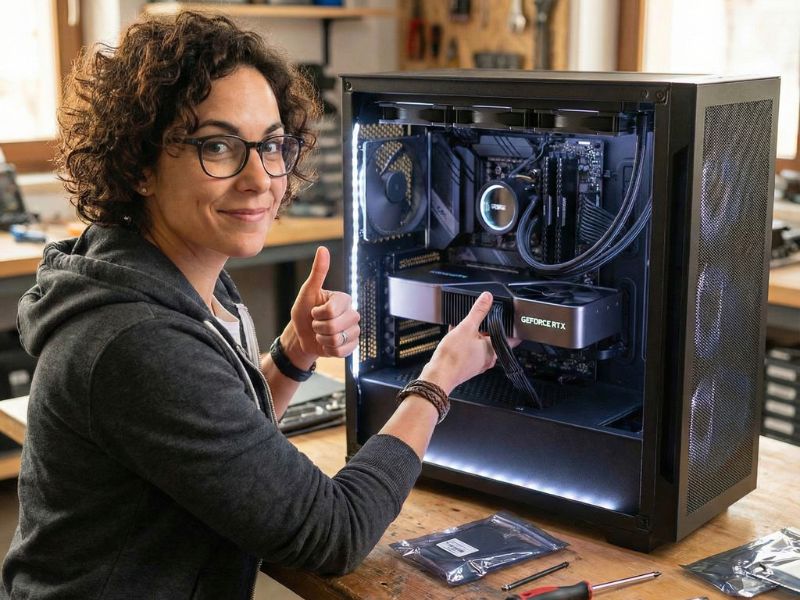
My personal pick for 2025 builds: The RTX 4060 takes the crown.
If even these prices are too high for you, don’t worry. You can still game on a tighter budget—check out my guide on The Best Budget Graphics Card Under $150.
FAQs: Quick Answers
Is the RTX 4060 worth the extra money over the RX 7600?
For most gamers, yes. The RTX 4060 costs about $30-$40 more but delivers superior power efficiency, better Ray Tracing, and access to DLSS 3 Frame Gen, which extends its lifespan significantly.
Is 8GB of VRAM enough for 1080p gaming in 2025?
It is passable but borderline. For 1080p High settings, 8GB works for 95% of games. However, you may need to lower texture settings in unoptimized titles to avoid stuttering.
What power supply do I need for the RTX 4060?
The RTX 4060 is incredibly efficient. A quality 500W PSU is more than enough for an entire system running this card, whereas the RX 7600 is safer with a 550W or 600W unit.
Do these cards support 1440p gaming?
They can do 1440p in older esports titles (League, Valorant), but for modern AAA games, they are strictly 1080p cards. You will struggle to hit 60 FPS at 1440p without heavily relying on upscaling.

